
Cześć! Welcome to Warsaw, the capital of Poland and one of its most popular travel destinations. Rich but grim history, delightful old town, quirky architecture mix, interesting museums, many green spaces, delicious food… Combine it with fairly cheap flights from many European cities and you’ll get a perfect travel destination! As Poles, we’ve visited this town a couple of times and today we want to show you amazing things to do in Warsaw, Poland. Both well-known tourist attractions and some lesser-known gems are waiting for you!
Interesting fact. Warsaw’s name in Polish is Warszawa. And among Poles, it’s often called Wawa (say it like ‘Vava’).

This website uses affiliate links thanks to which we may earn a commission for purchases you made at no additional cost to you. If you like the content, consider using those links to support us. Thank you!
Warsaw, Poland FAQ
Warsaw is located in east-central Poland on the River Vistula. It’s the capital and largest city of the country and the capital of the Masovian Voivodeship, one out of 16 Polish administrative divisions. Warsaw is also the 7th most populous city in the European Union.
Warsaw is best known for being the capital city of Poland. It’s a town with a brutal history and a lot of spilled blood. Warsaw endured the horrors of World War II and was almost completely wiped out. But over the last century, it rose from the ashes like a phoenix making it a modern and vibrant city full of life.
Yes, Warsaw is an interesting place where you’ll immerse yourself in history, where old is intertwined with new and beautiful with shabby. There you’ll find a bizarre mix of modern glass skyscrapers, concrete giants, and charming medieval-style squares. With so many things to do in Warsaw, this vibrant city offers something for everyone.
Two full days will give you enough time to see all the most important places in Warsaw and get a good feel of what this city is all about. But if you want to experience it more, we recommend staying for around 3-4 days. If you only have one day in Warsaw, you’ll be able to explore the best of the best too!
Warsaw is a walkable city and most of the main attractions aren’t located too far from each other but to get to some places you’ll need to use public transport (bus/metro/tram). But don’t worry – the city is well-connected! Just use jakdojade.pl to quickly find connections you might need.
In our opinion, the best time to visit Warsaw is late spring or early autumn – the weather is warm and sunny, there are fewer crowds, and the prices are a bit lower. Summer months will be ok too, if you have nothing against slightly bigger crowds. We advise against visiting Warsaw during the winter months as the quality of air is usually quite bad, days are very short, and you’ll be lucky to see a ray of sun.
Things to do in Warsaw, Poland
Warsaw Old Town
Warsaw Old Town is one of the prettiest areas of the city and home to many important landmarks. Here you can admire beautiful townhouses, take a photo with the famous Mermaid, explore the former residence of the Polish monarchs, and taste local cuisine in one of the restaurants or cafes. Exploring the old town is one of the most important things to do in Warsaw which should be included in every city guide.
But Warsaw Old Town wasn’t always like this. It was almost completely destroyed during World War II during the Warsaw Uprising in August 1944. Over the next few years, it was meticulously reconstructed, making it finally a beautiful place full of life. In 1980, Warsaw Old Town was declared a UNESCO World Heritage Site.
In Warsaw Old Town you’ll find points of interest like Castle Square, Royal Castle, St. Anne’s Church with observation deck, Warsaw Market Square with Mermaid sculpture, Barbican, or Royal Route. The area is best explored on foot.
Warsaw Tourist Office is located in Plac Zamkowy square just a few steps from Royal Castle.
If you want to learn even more about Warsaw and its history, you can do it with a guided tour. We recommend this popular and well-rated Warsaw Old Town Highlights Walking Tour in English.

Castle Square
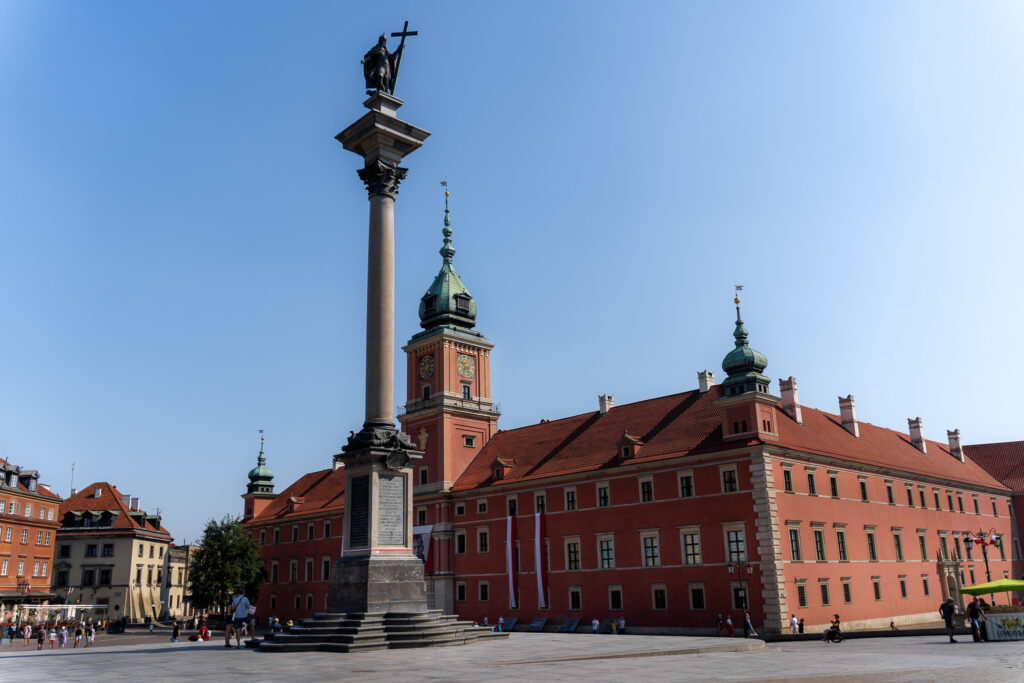
Castle Square (pl. Plac Zamkowy) is a large square located in the heart of Warsaw’s Old Town. It was razed to the ground by order of Adolf Hitler in 1944 and rebuilt in later years in a uniform architectural style. Here you’ll find some of the city’s most iconic landmarks, including the Royal Castle, St. Anne’s Church, and Sigismund’s Column (pl. Kolumna Zygmunta) – monument honoring King Sigismund III Vasa, who moved the seat of government from Krakow to Warsaw in 1596. The famous Royal Route also begins right here at Castle Square. Among the things to do in Warsaw, a visit to Castle Square is simply a must.


Royal Castle
Royal Castle (pl. Zamek Królewski) is a reconstructed 14th-century red-colored palace proudly standing in Castle Square. For hundreds of years, it served as the residence of Polish monarchs, both kings and presidents. Nowadays, it’s a museum housing an impressive art collection and historical artifacts. It might not look too spectacular from the outside, but its interior is quite dazzling, and exploring it is one of the most interesting things to do in Warsaw, not only for history/art lovers.
There are various ticket options available for Royal Castle, starting from 60zł for a normal ticket and 45zł for a reduced one (October 2025). The most popular ticket option is called ‘The Royal Route’ and will take you through the most important places. The castle is closed on Mondays, and on Wednesdays the entrance is free for permanent exhibitions. For current prices, opening hours, and online tickets, visit the zamek-krolewski.pl website.

Royal Castle Gardens
Royal Castle Gardens are a true hidden gem in Warsaw, often missed by many tourists. They consist of two parts, upper and lower, which you can access either from the Castle Square area or Wybrzeże Gdańskie Street. It’s an ideal place for peaceful walks, admiring colorful flowers, or just relaxing on a bench or soft grass. It’s also a great place to admire castle’s façade from its other side. Royal Castle Gardens are especially charming in the warmer months when everything is in full bloom. And the best part? Entry is free during opening hours.

Wishing Bell
Close to the Royal Castle, you can also find the Wishing Bell (pl. Dzwon na Kanonii), the main star of the local fairytale with a tragic ending (obviously). Nowadays, some believe that if you touch the bell while walking around it, your wish will come true. You can try, no harm done!
Near the Wishing Bell, you can also find the street leading to Dung Hill (pl. Gnojna Góra). It’s a lookout with nice views over the Vistula River and PGE Narodowy stadium.


St. Anne’s Church & observation deck
St. Anne’s Church (pl. Kościół św. Anny) is located in the heart of Warsaw Old Town, featuring a beautiful Neoclassical facade and an elegant, richly decorated interior. However, the real highlight is the panoramic view from the observation deck at the top of its bell tower. After climbing 150 steps, you’ll be rewarded with great views of Castle Square, Vistula River, Palace of Culture and Science, the city’s skyscrapers, and more. Visiting this spot is definitely one of the most memorable things to do in Warsaw, and a must for anyone who loves great views.
Entrance to St. Anne’s Church is free. However, entrance to the observation deck costs 15zł for a normal ticket and 10zł for a reduced one (October 2025). For current ticket prices and opening hours visit taraswidokowy.pl website.
Royal Route
Royal Route (pl. Trakt Królewski) is one of the most famous historic streets in Warsaw. It begins at Castle Square and leads directly to the Wilanów Palace. It’s about 10 kilometres long, but don’t worry, you don’t need to walk it all – the most interesting and important part is between Castle Square and the Charles de Gaulle Roundabout, including two streets: Krakowskie Przedmieście and Nowy Świat.
Along Krakowskie Przedmieście street you’ll find points of interest like the Presidential Palace, Hotel Bristol – a beautiful historic five-star luxury hotel, Holy Cross Church – famous for being home to the heart of Fryderyk Chopin, and iconic bronze statue of Nicolaus Copernicus. Here, you’ll quickly understand why walking along Royal Route is one of the best things to do in Warsaw.
Nowy Świat street is always full-of-life, lined with restaurants, cafes, and small shops. It ends at the Charles de Gaulle Roundabout, easily recognizable by its giant steel palm tree which is quite an unexpected sight in Warsaw! Right next to the roundabout, there’s also a National Museum with Polish and world art from ancient to contemporary times – an amazing place in Warsaw for art lovers!


St. John’s Archcathedral
In the street connecting Castle Square with Market Square, you’ll find St. John’s Archcathedral (pl. Archikatedra Warszawska) whose history dates back to the 14th century. During the Warsaw Uprising, the church was a battlefield, and Germans even managed to bring a tank loaded with explosives inside destroying a huge part of the building. After the fall of the uprising, the rest of the cathedral was blown up with TNT charges. Later it was reconstructed in Gothic style. Entrance to St. John’s Archcathedral is free.
Old Town Market Square
Colorful and vibrant Warsaw’s Old Town Market Square (pl. Rynek Starego Miasta) is the prettiest and most picturesque part of the city. And it’s hard to believe it’s no older than 70 years! Like everything else in the area it was blown up by the German Army after the Warsaw Uprising and restored to its prewar appearance in the 1950s. Today, it features beautiful townhouses, the iconic Mermaid statue – the symbol of Warsaw, and numerous restaurants and cafes. Strolling through the Old Town Market Square and discovering every hidden corner is without a doubt one of the most unforgettable things to do in Warsaw.
In one of the townhouses, you can find the Museum of Warsaw, where you can learn more about city history from the 14th century to modern times. If you’re up for some fun, take a look at Museum World of Illusion.


Barbican & City Walls
Warsaw’s Barbican (pl. Barbakan) is a semicircular fortified outpost dating back to the 16th century that was once part of the city’s defensive walls. It was largely destroyed during World War II and partially reconstructed in the mid-20th century, making it one of the most iconic landmarks in Warsaw today. While there, be sure to take a nice stroll along and even on the walls. Looking for the best place to admire the Barbican? Head to the intersection of Podwale and Nowomiejska streets.
If you want to explore the area even more, close to the Barbican, you’ll find places of interest like the sculpture of the Little Insurgent honoring the child soldiers of WWII, the baroque Krasiński Palace with magnificent gardens, the Warsaw Uprising Monument commemorating the sacrifice of anti-Nazi resistance fighters in the summer of 1944, and the stunning building of the Supreme Court.

POLIN Museum of the History of Polish Jews
If you want to learn about the history of Polish Jews, direct your steps to the POLIN Museum, located about 15 minutes on foot from the Barbican. It’s a modern museum with many interactive exhibits and various historical artifacts, covering over 1000 years of Jewish history in Poland, from the Middle Ages until today. Visiting the POLIN Museum is an enriching experience and one of the most meaningful things to do in Warsaw.
Entrance to POLIN Museum costs 45zł for a normal ticket, 35zł for a reduced one, and is free on Thursdays (October 2025). The museum is closed on Tuesdays. For current prices, opening hours, and online tickets visit polin.pl website. Have in mind that this museum is quite large, and to explore it thoroughly you’ll need about 3 hours.
Warsaw New Town
Warsaw New Town (pl. Nowe Miasto) is a small area of the city that starts right behind the Barbican Walls. There you’ll find Maria Skłodowska-Curie Museum – a place where you’ll learn about the life of a Polish 2-time Nobel laureate, St. Hyacinth’s Church – known for its white interior, New Town Market square with the baroque Church of St Casimir, gothic Church of the Visitation of the Blessed Virgin Mary, and Multimedia Fountain Park – complex with 367 water jets presenting music shows after dark from May to September. Restaurants, cafes, and small shops are there too.


Tomb of Unknown Soldier & Saxon Garden
Another important stop in Warsaw is the Tomb of Unknown Soldier (pl. Grób Nieznanego Żołnierza) located on Piłsudski Square. It’s a monument to the unknown Polish soldiers killed during World War I. Since 1925 the tomb houses the unidentified body of a young soldier, and the pillars contain urns with soil from battlefields where Polish soldiers fought. The Tomb is constantly lit by an eternal flame and guarded by two soldiers. Be sure to be there at full hour to see the ceremonial guard change. Visiting this site is one of the meaningful things to do in Warsaw.
Saxon Garden (pl. Ogród Saski) is a beautiful, green public park behind the Tomb of Unknown Soldier. There, you’ll find tree-lined walking paths, Baroque statues, and a big fountain. Currently, the garden is the last standing remains of Saxon Palace which was destroyed during WWII. But as for the end of 2025 works are in progress to rebuild the palace from scratch, so probably in a few years we’ll see it in its full glory!



Explore local attractions
Palace of Culture and Science
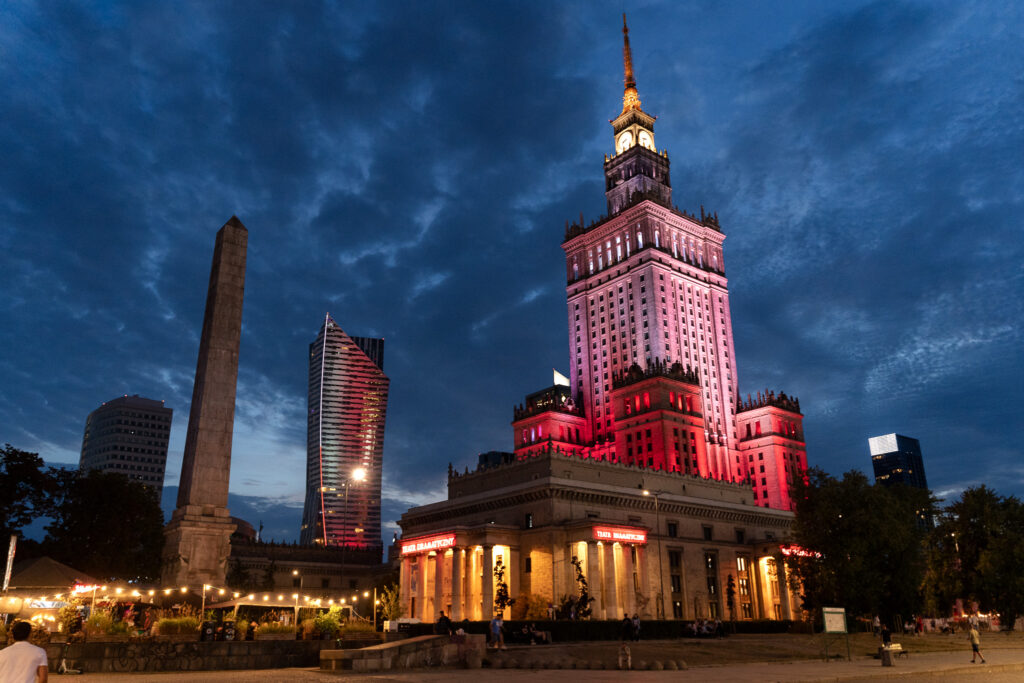
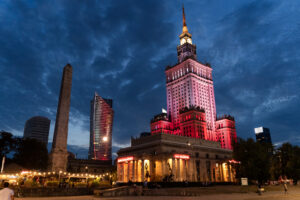
When most people think of Warsaw, the Palace of Culture and Science (pl. Pałac Kultury i Nauki) is usually the first landmark that comes to mind – and it’s easy to see why! This iconic building was built in the 1950s and has a total height of 237 metres (which makes it the second tallest building in Poland). Palace of Culture and Science was actually an unwanted gift from the Soviet Union, first known as Joseph Stalin’s Palace of Culture and Science, but it was changed in the wake of destalinization.
Today, the building houses a various cultural institution, including theatre, museums, cinema, congress hall. There’s also Warsaw Tourist Office and viewing terrace. Visiting Palace of Culture and Science is one of the must-see things to do in Warsaw.
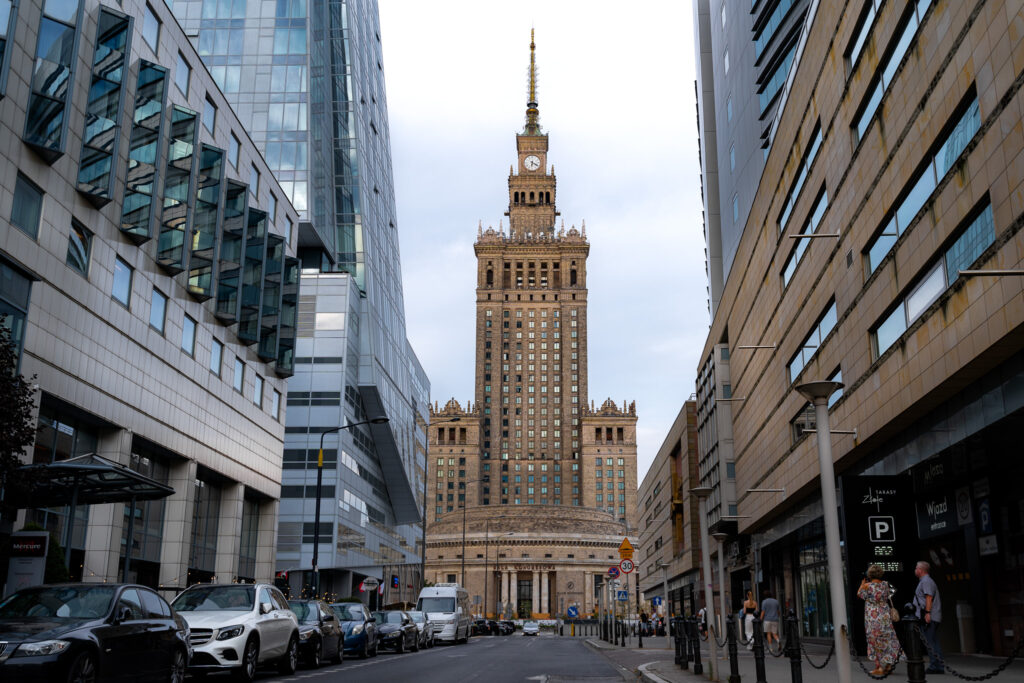

The biggest highlight of the Palace of Culture and Science is undeniably the viewing terrace. It’s located on the 30th floor and is reached in only 19 seconds by an elevator. From there, you’ll enjoy breathtaking 360-degree views over all faces of Warsaw – a truly unforgettable experience that quickly became one of the most popular things to do in Warsaw.
Entrance to the viewing terrace of Palace of Culture and Science costs 28zł for a normal ticket and 23zł for a reduced one (October 2025). You can either buy a ticket online or at the ticket office (which isn’t recommended if you care about time). For current prices, opening hours and online tickets, visit the bilety.pkin.pl website.
Travel tip. The Palace of Culture and Science looks impressive not only during the day but also at night when it’s beautifully illuminated (just look at the first photo in the post!). If you can, plan a visit after dark too to see the place in a whole new light.


Planning to extend your stay in Poland? 🤩
Warsaw Uprising Museum
Visiting the Warsaw Uprising Museum (pl. Muzeum Powstania Warszawskiego) is one of the most important things to do in Warsaw. It tells the story of the uprising which started in August 1944 to drive Germans out of the town. Fighting was brutal but despite lesser manpower and guns resistance fighters were able to hold for almost 2 months.
Results? Germans won, and most of the fighters were executed or deported to extermination camps (around 35k). In reprisal ordered by Hitler mass murders of civilians were carried out (150-200k) and Warsaw was almost completely destroyed by bombing. Also, around 500k civilians (lucky ones, we guess) were expelled from the city.
Today, inside the Warsaw Uprising Museum, you’ll find many exhibits, artifacts, videos, and photographs detailing this tragic Warsaw’s battle for independence. Don’t skip the short 3D film called “City of Ruins” showing an aerial video showing the devastation in Warsaw after the Nazi bombing. In our opinion, the amount of content within the museum is a little bit too overwhelming and hard to consume properly. But still, it’s a moving experience, often told in an interesting and thought-provoking way.
Entrance to the Warsaw Uprising Museum costs 35zł for a normal ticket, 30zł for a reduced one, and is free on Mondays (October 2025). The museum is closed on Tuesdays. You can either buy a ticket online or at the ticket office. For current prices, opening hours and online tickets visit 1944.pl website. Expect to spend at least 3 hours in the Warsaw Uprising Museum.


Royal Łazienki Park
Royal Łazienki Park (pl. Łazienki Królewskie) is a big green space in Warsaw, a perfect place if you need to spend some relaxing time in nature and away from the crowds. It featured not only many walking paths but also some stunning buildings.
In Royal Łazienki Park you’ll find points of interest like the 18th century Palace on the Isle (pl. Pałac na Wyspie), ruins of Amphitheater, Ujazdów Castle housing contemporary art museum, Botanical Garden, Belweder Palace, New Orangery, Chinese Garden, or Chopin Monument. But that’s not all – just wander around and for sure you’ll discover even more amazing places.
During the warm months, more or less from mid-May to the end of September, free Chopin concerts are held in the Royal Łazienki Park. For the newest information visit the ‘news tab’ on lazienki-krolewskie.pl website.


Museum of Life under Communism
Museum of Life under Communism (pl. Muzeum Życia w PRL) will take you back in time to the communist era in Poland which lasted from 1944 to 1989. There you’ll discover why Poland fell under communism in the first place, and thanks to many relics, artifacts, and life stories you’ll discover how everyday life looked back then. Compared to other popular museums in Warsaw, this one isn’t so grim and depressing.
We loved this museum. Thankfully, we didn’t have to experience the PRL period but seeing some items or how apartments/shops looked like certainly brought back some memories of our youth in the 90s. If you look for unique things to do in Warsaw, a visit to Museum of Life under Communism is a must.
Entrance to the museum costs 30zł for a normal ticket and 20zł for a reduced one (October 2025). You can either buy a ticket online or at the ticket office. For current prices, opening hours, and online tickets visit mzprl.pl website.


Vistula Boulevards
Another great place in Warsaw for a pleasant walk are Vistula Boulevards (pl. Bulwary nad Wisłą), a picturesque stretch along Vistula River. Long promenade, bridges, recreational areas, bars on boats, cafes, summer urban beaches, and nice views over the other shore await you there!
Travel tip. You can cross Świętokrzyski or Śląsko-Dąbrowski Bridge and you’ll find yourself in Praga District, an alternative and a little bit neglected part of Warsaw. Some will love it, some will hate it. Museums that might interest you there include Neon Museum with dozens of vintage neon signs, and Polish Vodka Museum with exhibits showcasing the history of vodka production, plus tastings.

Warsaw University Library Roof Garden
Warsaw University Library Roof Garden is one of the city’s best-kept secrets, located just a short walk from Vistula Boulevards and the Presidential Palace. It’s a small green oasis that sits literally atop the college library! There you’ll find diverse plants, beautiful flower beds, glasshouses, herb gardens, fish ponds, sculptures, and lawns perfect for picnics. You’ll also be treated to lovely views over Warsaw and the Vistula River. Entrance is free during opening hours. A visit to the roof garden is one of the best things to do in Warsaw if you need a peaceful escape from the bustling areas.

Copernicus Science Centre
A visit to Copernicus Science Centre (pl. Centrum Nauki Kopernik) is one of the coolest and most educational things to do in Warsaw. Interactive exhibits, planetarium, robotic and high voltage theatre, experimental zones, laboratories… So much fun for big and small ones!
Entrance cost to the Copernicus Science Centre depends on the type of ticket you want to buy (exhibitions only or exhibitions+planetarium) as well as the day of the week. Remember to buy online tickets in advance. Due to the place’s popularity, it’s almost impossible to get ones in the ticket office. Expect to spend at least 5 hours in the centre.
Near the Copernicus Science Centre, you’ll find Elektrownia Powiśle shopping mall located in the former power plant station. Besides shops, there’s a great food court, perfect to visit after exploring the Copernicus Science Centre.


Food in Warsaw
Warsaw is a real heaven for food lovers. No matter what you like, you’ll find it in Warsaw! From typical Polish dishes to a wide choice of international cuisine. We’ve already tried several restaurants and none of them have disappointed us. But we recommend checking out some options and reviews earlier – to avoid falling into some tourist trap with bad food.
What places do we recommend? For breakfast/lunch our number one is Bułkę przez Bibułkę, for typical Polish dishes for dinner head to GOŚCINIEC Polskie Pierogi, and if in need of coffee/tea/healthy juice and something sweet to eat choose Vita Cafe. All mentioned places can be found in several locations all across Warsaw.


Take advantage of a guided tour
If you don’t want to put too much effort into planning all the things to do in Warsaw, you can take advantage of the guided tours and let someone else take care of all the details.
During your stay in Warsaw, you can for example take part in this interesting and well-rated Warsaw Old Town Highlights Walking Tour. If you’re a foodie, we’re sure you’ll love this Cooking Class Of Making Polish Dumplings. Do you love cars? Then you might want to Explore Warsaw in Retro Fiat!
For a wide selection and more well-reviewed tour options be sure to visit GetYourGuide or Viator website.
How to get to Warsaw, Poland?
Warsaw is located about 290km from Krakow, 310km from Poznan, 340km from Gdansk, and 350km from Wroclaw. The most convenient way to get to Warsaw is by car, train, or bus.
Airports near Warsaw
There are two airports in Warsaw: Chopin Airport (only 10km from the city center) and Modlin Airport (40km from the city center). From each of them, you can get to city center by bus or train. You can also take a taxi or rent a car. To learn more about all possible transport options visit lotnisko-chopina.pl for Chopin Airport, and modlinairport.pl for Modlin Airport. You can also use rome2rio.com website.
Where to park in Warsaw?
If you choose to travel by car you need to know that it isn’t very easy to find a parking place for a car (especially a free one). Your best option is probably to find accommodation with parking space and then walk or travel by bus/tram/metro in Warsaw city center.
You can also leave a car in one of the underground parking lots, like Parking Warsaw Spire or Interparking Piękna, or try to find a place along the streets and pay by parking meter or via app.

To Warsaw by train
You can easily get to Warsaw by train, as Poland is quite well connected by trains. For example, a trip from Krakow will take about 2.5 hours, less than 3 hours from Gdansk, and about 4.5 hours from Wrocław. To learn more about connections that might interest you visit rozklad-pkp.pl or rome2rio.com website.
To Warsaw by bus
You can also easily get to Warsaw by bus, especially from other big Polish cities. For example, the trip from Gdansk will take around 5 hours, 4 hours from Krakow, and 5 hours from Wroclaw. To learn more about bus connections that might interest you visit rome2rio.com or Flixbus website.

Things to do in Warsaw, Poland – Summing up
We hope our Warsaw travel guide helped you choose great places to visit in the city and that now you’re ready for an exciting journey through history, culture, architecture, and nature. No matter if you want to explore all the corners of the old town, learn about the city’s turbulent history, visit unique museums, or do a rendez-vous in restaurants and cafes tasting local food… There are plenty of things to do in Warsaw that will satisfy every traveler’s taste. Enjoy your time!
Our video from Warsaw
Our opinion about Warsaw
Among Polish people, Warsaw is probably the most hated big city, and you won’t hear many flattering opinions about it (obviously, apart from the people living there). The city is more of a travel destination for foreigners than locals – not many Poles will go there of their own free will in their free time.
As for us, over the years we visited Warsaw a few times, first during school trips and later only on some business trips. And to be honest, we’ve also never really liked this city. Don’t get us wrong – it’s not bad, but for us it’s just not that interesting or beautiful like other places in Poland.
What do we like about Warsaw? The first thing that comes to mind is an amazing food scene. We also appreciate the large green spaces, and its charming old town. Warsaw is also a great place to learn an important history lesson. What do we dislike? We don’t like the concrete jungle and pompous and unpleasant people. Many homeless and drunk people in the center are quite overwhelming too.

Restaurants, accommodations, and map
Check out various recommended places below.
Where to eat in Warsaw?
Here are your best, high-rated options in Warsaw:

Warsaw surprised me with how much there is to do beyond the obvious sights. This guide makes a strong case for spending a few extra days exploring the city’s food and neighborhoods.
Saved this for my upcoming trip to Warsaw! The mix of history and modern spots sounds perfect, and it’s great to have so many options in one place. Can’t wait to explore some of these on foot.