Dzień dobry! Welcome to Poznan, one of the most beautiful cities in Poland. It’s one of the major travel destinations among Polish people but is still not well known to most foreign visitors. So if you’re up for visiting a hidden gem, you’re in a good place! Rich history, colorful old town, beautiful architecture, the most popular goats in the country, delicious local croissants, many green spaces… Add to that fairly cheap flights from many European cities, and you’ll get a perfect city break! Keep reading and discover the best things to do in Poznan in our travel guide.
As Poles, we’ve visited Poznan multiple times on various occasions and we just love coming back. After Wroclaw, it’s our second favorite city in Poland! There’s something really compelling about it!

This website uses affiliate links thanks to which we may earn a commission for purchases you made at no additional cost to you. If you like the content, consider using those links to support us. Thank you!
Poznan, Poland FAQ
Poznan is located in the western part of Poland on the banks of the Warta River. It’s the capital of the Wielkopolska Voivodeship, one out of 16 Polish administrative divisions. Poznan is the 5th biggest city in the country.
Poznan is best known for its beautiful old town full of colorful townhouses, a Town Hall with a clock with mechanical goats that bump their heads daily, the oldest Polish cathedral, delicious Saint Martin’s croissants, and local dishes with pyry (potatoes).
Of course! Poznan is an amazing city in Poland, definitely worth your time. It’s colorful, beautiful, friendly, tasty, and full of green spaces. It’s a big city that managed to keep the small town feel. In Poznan, you’ll find a wide variety of activities – from immersing into history and exploring the nooks and crooks of the old town to tasting delicious local dishes and visiting interesting museums. For sure, Poznan will please every traveler’s taste.
You can discover the most popular places in Poznan in one day as the city is quite compact and the main attractions aren’t too far from each other. However, if you want to get to know it better, without rushing, we recommend staying for at least 2-3 days.
Poznan is a walkable city and the main landmarks are close to each other. Sometimes you might need public transport (bus/tram) but don’t worry as the city is well connected. You can use jakdojade.pl to quickly find connections you might need.

Our travel video from Poznan
Things to do in Poznan, Poland
Old Market Square
Old Market Square is one of the most beautiful squares you’ll see in Poland. And it has been the heart of the city since 1253! Back then, buildings were made of wood, and narrow brick houses began to appear in the 16th century. Famous colorful Merchant Houses once used to be wooden stalls selling items like fish, candles, or salt.
During World War II, buildings around the market square were badly damaged, but later they were carefully rebuilt to the look we can admire today. Thankfully!
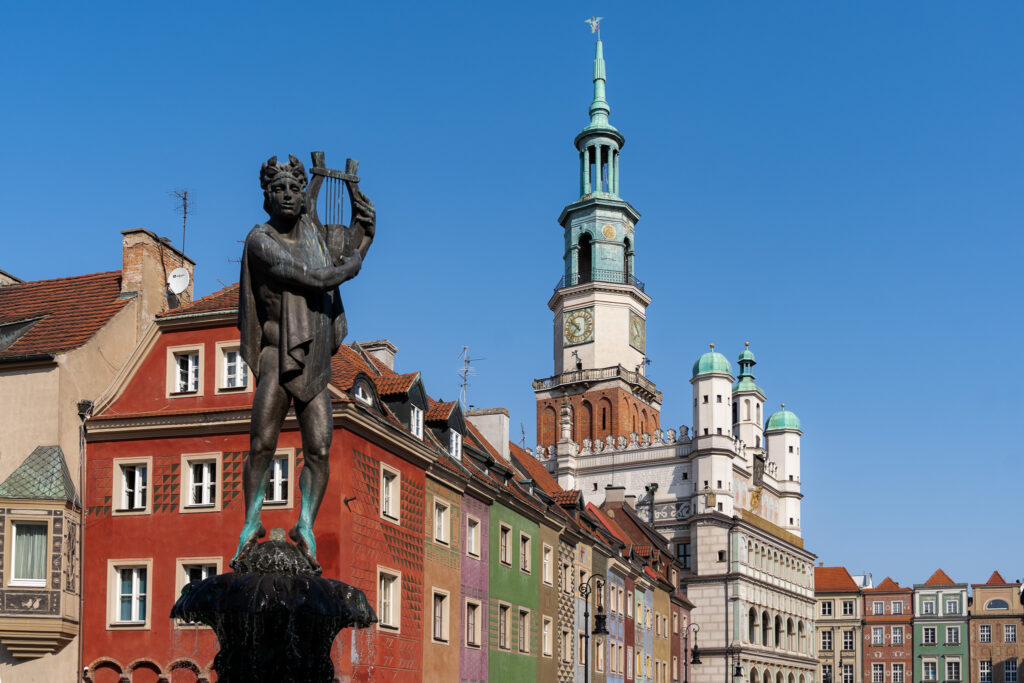
Nowadays, Poznan Old Market Square is vibrant, colorful, and full of life. There, you’ll marvel at beautiful Renaissance-style townhouses (every single one is unique!), take a photo with a row of picturesque Merchant Houses, watch the goats clattering their heads on the top of Town Hall, and eat traditional Saint Martin’s croissant.
There, you’ll also find many restaurants and cafes, and a few museums. Strolling around Old Market Square is definitely one of the best things to do in Poznan!
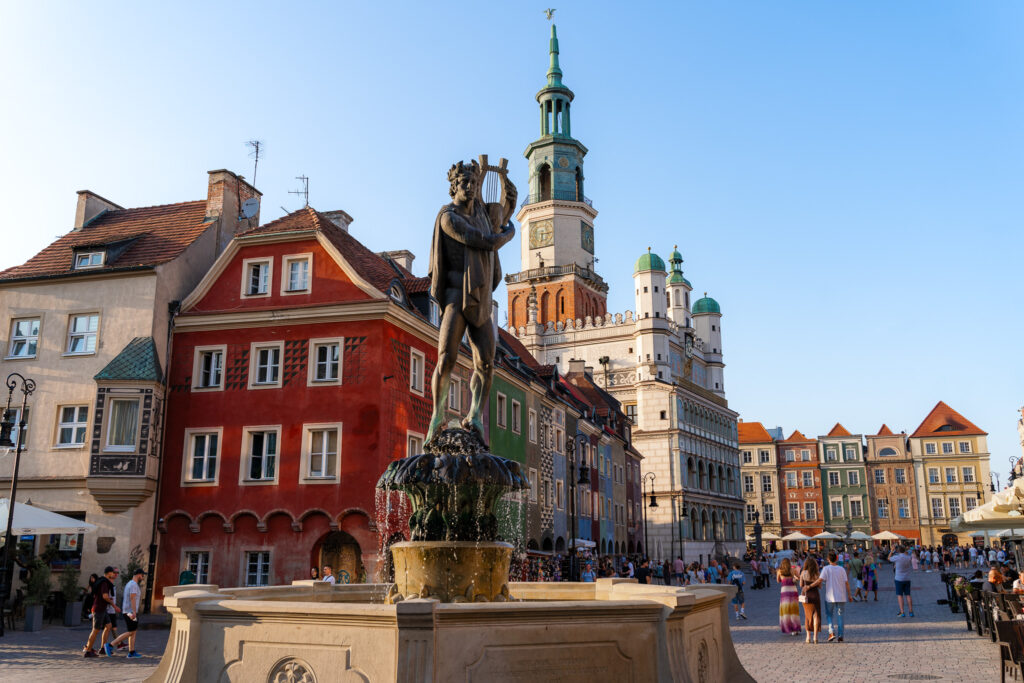
Among points of interest in Poznan Old Market Square you’ll find Town Hall, medieval pillory, Merchant Houses, Croissant Museum, four mythological fountains (featuring Mars, Proserpina, Neptune, and Apollo), and Bamberka Monument.
Poznan Tourist Office is also located on Market Square (Stary Rynek 59/60). There, you’ll get free materials and comprehensive information about Poznan attractions.
If you’re into museums, you can check out Museum of the Wielkopolska Uprising of 1918-1919 (showcasing the story of the victorious uprising and how the people of Greater Poland won their freedom) and Archaeological Museum (a collection of centuries-old artifacts from the ancient cultures of Greater Poland to ancient Egypt).



Town Hall & Famous goats
Town Hall (pl. Ratusz) is the most impressive building in Old Market Square, a pearl from the Renaissance time. It dates back to the 16th century, but its first version was there already in the late 13th century! Town Hall used to serve as the seat of the local government until 1939. Currently, it houses the Poznan Museum with exhibitions showcasing the history of the city from the 13th century to 1954.
But it’s not just the compelling appearance of the Town Hall that interests visitors… They come here to see two fighting goats! Yes, every day at noon and 3 pm famous two goats appear on its tower (door above the main clock) and clatter 12 times, accompanied by the sounds of the trumpet call. It’s one of the most peculiar and popular things to do in Poznan, so be sure to find a good spot!


Where exactly did these two fighting goats come from? Of course, there’s a whole legend behind them and here you can read it. And if you want to take a closer look at the goats, inside the Poznan Museum you can find figures of original ones from 1913, from the old clock mechanism.
Travel tip. Not far from the Town Hall, on Plac Kolegiacki square, you will find Poznan Goats Sculpture of two life-size goats, engaged in their favorite activity – head butting. Need even more goats? Look for a mural called “Dzień Dobry w Poznaniu” (Good Morning in Poznan) on Piekary Street, also close to the Old Market Square.
Interesting fact. Pyrek and Tyrek – these are the names of Poznan goats. The name Pyrek refers to the dialectal name for potato, and Tyrek comes from the Polish word “tyrać” which means working hard.

Poznan Fara
Poznan Fara (pl. Fara Poznańska) is a Catholic minor basilica located within Poznan Old Town. Its full name is quite long and hard to remember – Basilica of Our Lady of Perpetual Help, Mary Magdalene, and Saint Stanislaus. No wonder they made it shorter! Fara was built in only 50 years, between 1651 and 1701. It’s one of the best examples of Baroque architecture in Poland.
From the outside, it’s characterized by a unique pink and white facade. But be sure to enter inside as its interior is equally beautiful, if not even more. Take a good look at monumental Corinthian columns, 19th-century Friedrich Ladegast’s organs, and all the frescoes and decorations. Entrance to Poznan Fara is free during opening hours.


Croissant Museum
Croissant Museum (pl. Rogalowe Muzeum) is located in one of the beautiful townhouses in Old Market Square. It’s a place dedicated to St. Martin’s croissant (pl. Rogal Świętomarciński), Poznan’s traditional croissant with white poppy-seed filling whose recipe and name are protected under EU law.
But Croissant Museum isn’t really a museum, at least not in the traditional sense of this word. It’s more of a mix of baking demonstrations and storytelling. If you want to learn how to create a croissant according to the original recipe and also get to know the history and traditions behind it – it’s definitely a place for you!

The museum hosts shows in Polish and English. During summer months (July and August), shows in English take place daily, but during the rest of the year only on Saturdays and Sundays. What’s more, the show in English at 2 PM includes the view of Poznan goats at 3 PM from museum windows! The same goes for the show in Polish at 11 AM if you know the Polish language.
Remember to book your spot in advance online. Normal ticket to Croissant Museum for an English show costs 47zł, and only 1zł for children under 3 years old (September 2026). For current prices, opening hours, and online tickets visit rogalowemuzeum.pl website.
Taking part in one of the shows in Croissant Museum is without a doubt one of the most delicious things to do in Poznan Poland. Don’t skip it!


Royal Castle
Royal Castle (pl. Zamek Królewski) is located just a few steps from Old Market Square, on a small hill called Góra Przemysława. It dates back to the 13th century but unfortunately was destroyed and rebuilt several times throughout its history. Last time it was badly damaged during World War II and since then was partly rebuilt.
Nowadays, you can admire a modern reconstruction that is home to the Museum of Applied Arts (pl. Muzeum Sztuk Użytkowych) with a unique collection of 2000+ utility items from the Middle Ages until modern times. The ticket price also includes an entrance to the 43-meter-high tower from which you can take a look at the old town and its surroundings.
Entrance to Royal Castle costs 20zł for a normal ticket, 13zł for a reduced one, and is free on Tuesdays (September 2026). For current prices and opening hours visit mnp.art.pl website. Exploring the castle is such a great thing to do in Poznan for history lovers.

Plac Wolnosci
Plac Wolności, the Freedom Square, is a beautiful square located close to Old Market Square and Royal Castle. It’s a popular meeting place for locals, and an area with some impressive 19th century buildings – especially take a look at Raczyński Library. It also features a marvelous Fountain of Freedom, perfect for taking unique photos. If you’re looking for the best things to do in Poznan, strolling through Freedom Square should definitely be on your list.

Planning to extend your stay in Poland? 🤩
Imperial Castle
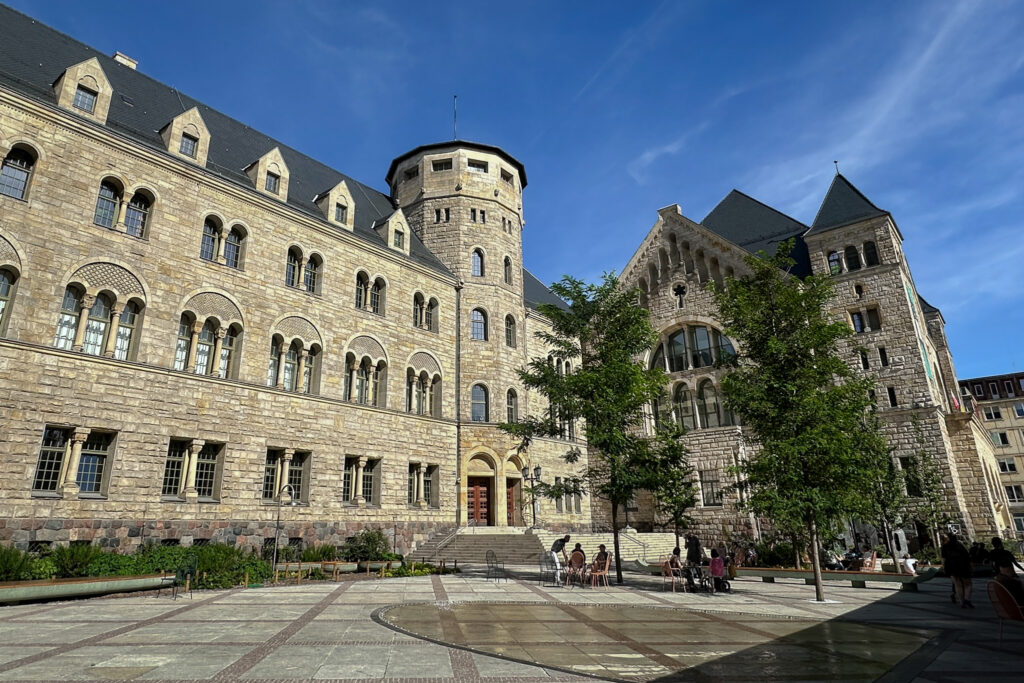
Imperial Castle (pl. Zamek Cesarski) is a magnificent building built under German rule between 1905 and 1910 for Wilhelm II – German Emperor and King of Prussia. Its name is actually quite deceiving as it’s more of a palace than a castle. Imperial Castle is Europe’s youngest monarchical residence.
Since its construction, its purpose changed a few times – until 1918 it housed German government offices, in the interwar period (1918-1945) university lectures were held in its halls, during World War II it was adapted to serve as Hitler’s headquarters, and since the 1960s it has functioned as a cultural center.

Nowadays, inside Imperial Castle, there are places like a cinema, concert hall, library, exhibition spaces, and cafes. Among its walls, you’ll also find Poznań Uprising Museum – June 1956 – a museum devoted to Poznan’s anti-communist protests of 1956.
You can also explore some of the castle’s historical rooms – you can do that with a map, an audio guide, or a castle guide. The entrance to Imperial Castle is paid and the cost depends on the sightseeing way you choose. For more information, prices, and opening hours visit ckzamek.pl website.
Just across the street, you’ll also find a fascinating Enigma Cipher Centre.

Adam Mickiewicz Square
Right next to Imperial Castle there is Adam Mickiewicz Square. In the area, you’ll find points of interest like Adam Mickiewicz monument, the enormous Monument to the Victims of June 1956, Adam Mickiewicz University, Park Mickiewicza with a beautiful fountain, Grand Theater, and a small model of the Castle District. Nice place for a peaceful break!

Cathedral Island: Ostrów Tumski
Ostrow Tumski is an island between two branches of the Warta River. It’s the oldest area of Poznan where in the 10th century a fortified stronghold and residences of Mieszko I, the first recorded ruler of Poland, were located. It was one of the main political centers of the Piast domains which was the hub of the early Polish state. It’s also a highly probable place of Mieszko’s baptism in 966, which was a defining moment in the Christianization of the Polish state.
Nowadays, Ostrow Tumski is home to Poznań Cathedral, the oldest cathedral in Poland. Its construction followed Mieszko I baptism in the 10th century. It’s also a place of burial of the first rulers of Poland, like Mieszko I or his son, Bolesław Chrobry.
Entrance to Poznan Cathedral is free, although entrance to the crypts costs 10zł for a normal ticket and 8zł for a reduced one (September 2026). For current prices and opening hours visit katedra.archpoznan.pl website.


Porta Posnania
If you want to learn more about the beginnings of the Polish state and the Cathedral Island, visit Porta Posnania (pl. Brama Poznania). It’s a modern and interactive museum with no typical exhibits, presenting history with multimedia and light.
Entrance to Porta Posnania costs 35zł for a normal ticket and 29zł for a reduced one (September 2026). For current prices and opening hours, visit bramapoznania.pl website.
Travel tip. While in the area, you can also take a short detour to see the huge and colorful Mural Śródka. It’s also a great place to take a short break in one of the nearby restaurants or cafes.

Lake Malta
If you wish to spend some time in nature in Poznan, head to Lake Malta (pl. Jezioro Maltańskie) located close to Cathedral Island. It’s an artificial lake in a scenic spot surrounded by parks and woodlands, popular among locals especially during warm days. Lake Malta is an excellent place to escape the city’s hustle and bustle.
In Lake Malta’s surroundings, you can find places like New Zoo, Malta Ski – sports and recreation center, and Thermal Baths. The first two will be perfect to visit if you are traveling with kids.
There is also a Maltanka Train in which you can take a 3.8km-long trip along the northern shores of Lake Malta – from Rondo Śródka to the New Zoo. An interesting fact is that the carriages are still powered by the Borsing steam engine from 1925! Maltanka Train runs from April to the end of September or mid-October. For more information, current prices, and train timetable visit mpk.poznan.pl website.


Citadel Park
Citadel Park (pl. Park Cytadela) is the biggest park in Poznan, located about 20 minutes on foot from Old Market Square on a site of the 19th-century fort. It’s a perfect place for a leisurely stroll among green spaces, having a picnic, or even learning more about the past. Here, both nature and history lovers will be pleased. In our opinion, visiting Citadel Park is one of the most relaxing things to do in Poznan Poland – we spend many lovely hours there.
In Citadel Park you’ll find points of interest like a rosarium, a unique Nierozpoznani sculpture, large obelisk, remnants of the old fort, amphitheater, and two museums which will be a treat for military enthusiasts: Museum of Armament (pl. Muzeum Uzbrojenia) and Museum of the Poznań Army (pl. Muzeum Armii Poznań).



Explore local attractions
How to get to Poznan, Poland?
Poznan is located about 180km from Wroclaw, 250km from Berlin, and 300km from Warsaw or Gdansk. The most convenient way to get to Poznan is by car, train, or bus.
Airports near Poznan
Poznan has its own airport. The next closest ones are in Wroclaw (180km away) and in Berlin, Germany (250 km away).
The easiest way to get from Poznan airport to the city center is to take a bus (line 159, 148, or 222). You can also take a taxi or rent a car. To learn more visit poznanairport.pl.
From airports outside Poznan, you can catch a direct bus too. To learn more about connections that might interest you, visit rome2rio.com website.
Where to park in Poznan?
If you choose to travel by car you need to know that it isn’t easy to find a parking place for a car (especially a free one). Your best option is to find accommodation with parking space and then walk or travel by bus/tram in the city center.
You can also leave a car in one of the underground parking lots, like MTP Parking or Interparking Plac Wolności, or try to find a place along the streets and pay by parking meter or via app. To learn more about parking options in Poznan, visit visitpoznan.pl website.
To Poznan by bus
You can easily get to Poznan by bus, especially from other big Polish cities. For example, the trip from Wroclaw will take 2.5 hours and 4 hours from Warsaw, and 3.5h from Berlin. To learn more about bus connections that might interest you, visit rome2rio.com or Flixbus website.
To Poznan by train
You can also get to Poznan by train, as Poland is quite well connected by trains. For example, a trip from Wroclaw will take about 1.5 hours, 2.5 hours from Warsaw, and 3 hours from Gdańsk. To learn more about connections that might interest you, visit rozklad-pkp.pl website.

Poznan Poland Travel Guide – Summing up
Poznan is such a delightful city, isn’t it? It’s colorful, charming, interesting, and tasty. Poznan is definitely one of the best cities in Poland. And we hope that now you understand why it should be visited along with other popular names like Krakow, Gdansk, or Warsaw.
Even though Poznan is one of the biggest cities in Poland it managed to keep a smaller town vibe. We hope that now, with our Poznan travel guide, you’re ready to explore the city in the best possible way. Enjoy!
Our opinion about Poznan
We love Poznan. Over the last few years, we’ve visited it a couple of times on many different occasions and for sure we’ll visit it many more times! Out of all the big Polish cities, after Wroclaw, it’s the next one we know best.
We like its vibe, colors, uniqueness, green spaces, and of course the food. Also, at least for now, it’s a much less crowded city to explore – which for us is a huge advantage. What we don’t like? To be honest, nothing particular comes to mind!

Restaurants, accommodations, and map
Check out various recommended places below.
Where to eat in Poznan?
Here are your best, high-rated options in Poznan: